By 2030, urban land cover in North America is projected to nearly double its extent from the year 2000 (Seto et al., 2012). Much of this development will be concentrated along urban corridors, like the Eastern Seaboard (Nowak & Walton, 2005). Increased impervious surface due to urban development results in hydrologic impacts such as: Increased flashiness, greater magnitude and frequency of storm flows, and changes to baseflow due to reduced infiltration surface (Walsh et al., 2005). With impervious cover replacing soil and vegetation, infiltration and recharge of watershed storage is reduced (Gregory et al., 2006). This increased runoff due to impervious surface necessitates the construction of stormwater systems to efficiently convey discharge to streams and reduce flooding of developed areas. Higher runoff efficiency to streams exacerbates the hydrologic impacts of urbanization (Leopold, 1968).

Illustration of urban hydrological impacts vs natural lands.
My research is funded as part of the National Science Foundation Urban Critical Zone Cluster, which studies the interaction between the geologic template and the urban footprint and the effects on critical zone processes along the Eastern Seaboard.

The “Critical Zone” refers to Earth’s outer skin, from the bedrock to the treetops. It is an environment where rock, soil, water, air, and life interact and shape the surface of our planet (Brantley et al., 2007).
Although hydrologic impacts scale with increasing impervious cover, physical factors (topography, stream morphology, lithology) influence the nature and magnitude of these impacts (Hopkins et al., 2015). Hydrologic responses to urbanization vary between and within physiographic regions. These variations due to physical factors are not well understood at smaller scales (Hopkins et al., 2015). East Coast rivers crossing the Atlantic Fall Zone straddle multiple physiographic regions and exhibit spatial variations within those regions. The Fall Zone marks knickpoints that propagate upstream from the Piedmont crystalline bedrock/Coastal Plain sediment boundary. Sharp increases in stream gradient, or knickpoints, occur where rivers cross this lithologic contact or where those knickpoints have propagated upstream (Bierman, 2015).
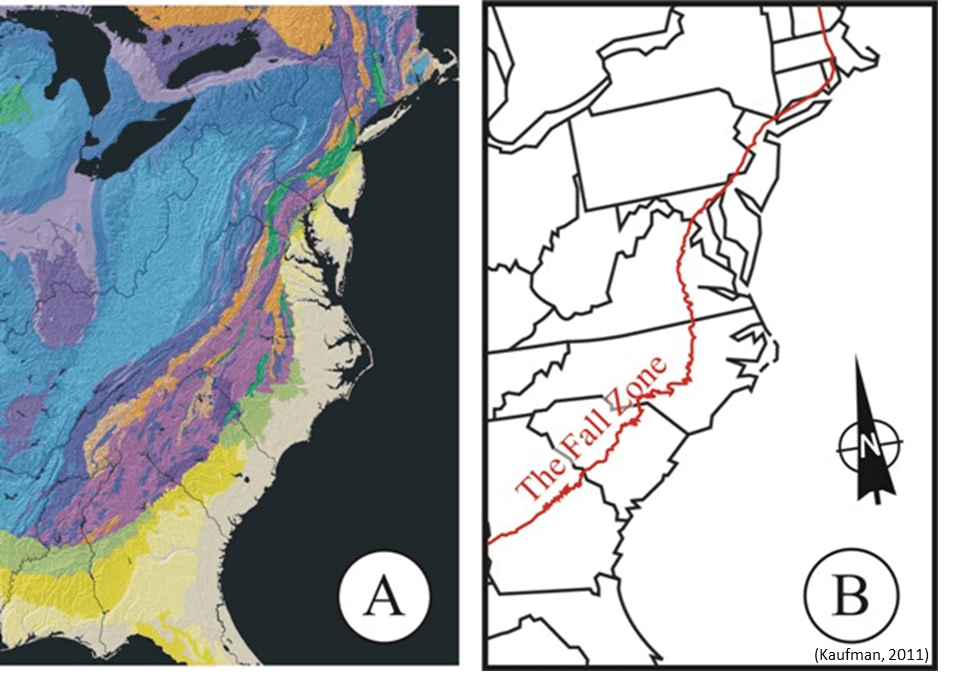
The Fall Zone marks the transition from Piedmont crystalline bedrock to Coastal Plain sediment. Impassable rapids formed on rivers crossing this contact. Many East Coast cities, including Washington DC, Baltimore, Philadelphia, Trenton, Richmond, and Raleigh sprung up along the Fall Zone to make use of hydropower and because ships could not travel any further upstream.
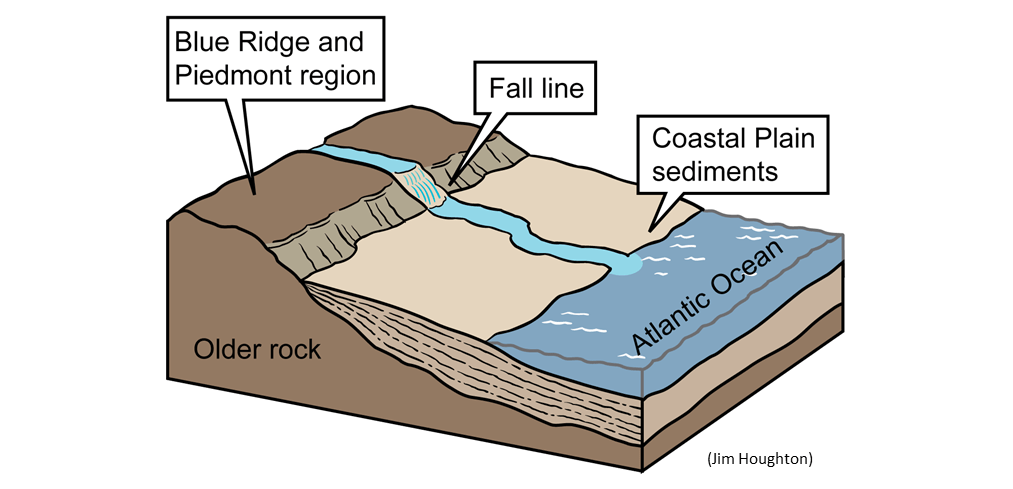
Knickpoint along the Fall Line. This sharp increase in stream gradient forms where erodible Coastal Plain sediment meets resistant Piedmont crystalline bedrock that the river has more difficulty incising through.
Knickpoints propagate upstream due to headward erosion, the rate of propagation is proportional to rock erodibility and stream power. Base level drops rapidly below the knickpoint (Penck, 1924). Tributaries to the mainstem incise downward to meet this lower base level, and this erosive signal is transmitted up the channel to the hillslopes of the sub-watersheds and on to the drainage divides. The landscape above the knickpoint does not receive this erosive signal and so differential incision along the mainstem results, with steeper channels and hillslopes below the knickpoint (Wegmann et al., 2011). These steepened tributary channels tend to take on a more convex profile as they rapidly incise downward to meet the drop in base level, departing from the concave upward profiles typical of a landscape in dynamic equilibrium (Seidl et al., 1994). New channels may be initiated to drain the steepened catchments, with an overall increase in drainage density (Perron et al., 2008).
Physical stream characteristics change downstream of knickpoints, and corresponding hydrological changes may occur within contributing watersheds. Groundwater fluxes from watershed storage increase with hillslope steepness, but this effect may be countered by soil permeability (Sayama et al., 2011; Tetzlaff et al., 2009). In regions where bedrock is shallow and relatively impermeable, like the Mid-Atlantic Piedmont, steeper watersheds with shallow bedrock may have reduced effective storage (Troch et al., 2003). A study of urban watersheds across the United States in various physiographic regions showed that flatter, more permeable terrain reduced the severity of hydrologic impacts due to urbanization (Hopkins et al., 2015). Portions of watersheds that are steeper and more eroded due to knickpoint adjustment may exhibit lower storage (baseflow) and perhaps higher storm runoff.
Due to scale-dependent factors, such as travel times, relief, etc. small watersheds (≤1-2 km2) may experience increased severity of hydrologic response due to urban impacts (Berthier et al., 2004; Meierdiercks et al., 2010; Yao et al., 2016). Small watersheds respond more rapidly to storm events, with shorter transfer times of runoff to the channel and faster lag times of discharge pulses moving downstream (Berthier et al., 2004). These shorter transfer times may limit runoff infiltration into the soil or streambed, reducing recharge of subsurface storage and increasing overland flow (Singh, 1997). These scale-dependent factors may enhance the speed and magnitude of hydrologic response of small watersheds to knickpoint adjustment, but the controls have not been well-studied. The catchments above and below the Fall Zone knickpoint studied in this project are small watersheds under 2 km2.
The goal of this project is to understand the effects of increased urban runoff on small tributaries to the Northwest Branch of the Anacostia River, an urbanized Fall Zone stream, and the physical factors that influence hydrologic response. We are examining how differential incision due to knickpoint propagation has influenced tributary morphology and soil thickness in the catchments available for subsurface storage, and how those physical factors affect baseflow and stormflow responses in the tributaries. Geomorphologic factors have not been incorporated effectively into current ideas on watershed storage and urban runoff response. We hope to better understand those controls with this project.
 john on earth